Understanding Maximum Allowable Quantities for Battery Energy Storage Systems
Jul 29, 2026
Battery energy storage systems have become one of the most talked about components in the renewable energy industry, bringing with them a growing set of questions around code compliance, fire safety, and site design. Among many other requirements, the International Fire Code (IFC) and NFPA 855 lay out clear “maximum allowable quantities” (MAQ) for these systems, thresholds above which additional requirements will come into play. .
Mayfield Renewables has spent nearly two decades sizing and siting solar and storage systems across a wide range of projects, and that experience shapes how we approach each project. In this article, we’ll discuss how we approach the issue of MAQ for stationary energy storage projects.
Key Points
- Lithium-ion MAQ in the 2024 IFC: 600 kWh
- Expected lithium-ion MAQ in the 2027 IFC: 20 kWh
- Exceeding MAQ requires a hazard mitigation analysis (HMA)
- Indoor sites generally have fewer compliance options
- As always, the AHJ has final approval authority
IFC Table 1207.5 and the 600 Kilowatt-Hour Limit for Lithium Ion Storage
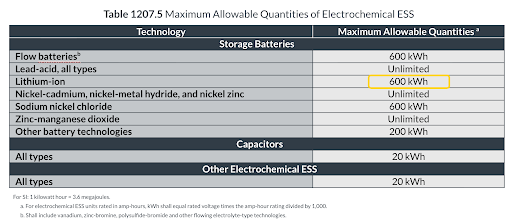
Table 1207.5 in the 2024 IFC lists the MAQ (per "fire area") for each electrochemical storage technology. Flow batteries and lithium-ion batteries are both capped at 600 kWh. Lead-acid, nickel-metal-hydride, and nickel-cadmium batteries are listed as unlimited. Other battery technologies not specifically named are limited to 200 kWh, and capacitors along with other electrochemical storage types are limited to 20 kWh. Since lithium-ion technologies dominate the stationary energy storage market today, those types of batteries will be the focus of the rest of the article.
Table 1207.5 is not the only IFC rule governing energy storage quantity. Section 1207.5.1 requires that electrochemical storage be segregated into groups (or units) not exceeding 50 kWh each, with a minimum of three feet of separation between groups and between each group and the walls of the storage room or area. Section 1207.5.2 then ties this back to able 1207.5 by stating that "fire areas" containing electrochemical storage cannot exceed the maximum allowable quantities listed, unless one or more exceptions apply.
Hazard Mitigation Analysis: What It Is and Why It Gets Expensive
Exception 1 to Section 1207.5.2 allows a "fire area" to exceed the maximum allowable quantities in Table 1207.5 (i.e., to go beyond 600 kWh of total capacity) if the design is supported by an approved hazard mitigation analysis (HMA) and large-scale fire testing performed in accordance with Section 1207.1.5. The word “and” is doing some heavy lifting here, requiring both an HMA and data from large-scale fire testing. This is intentional, because the large-scale fire test report will provide the product-level data needed for a fire protection engineer to develop a project-level HMA. An HMA evaluates how a specific installation would behave in a fire scenario, and it is written for the exact conditions of that site rather than as a generic reference document. Since every project location, layout, and hazards will be different, these reports typically run between a few thousand and tens of thousands of dollars for a single project—even a small one.
A recent Mayfield project in San Diego illustrates how quickly this cost consideration comes into play. The project called for three battery cabinets rated at 233 kWh each, for a combined capacity of about 699 kWh. That total put the design well beyond the 600 kWh maximum allowable quantity for lithium-ion storage in a single fire area, but the client wanted to avoid the added cost of an HMA. The solution? Turn one big “fire area” into two smaller fire areas by installing one of the cabinets (233 kWh) inside and two of the cabinets (466 kWh) outside. Reducing the capacity per fire area enabled the client to avoid an HMA, but opened up new challenges related to installing an energy storage system indoors.
Indoor vs Outdoor Battery Placement, Why Location Changes Everything
Where a battery system sits changes how much flexibility a design has around the maximum allowable quantity. Outdoor installations generally have more room to work with and more options for code compliance without triggering an HMA. Indoor installations are more constrained, since the room itself has to accommodate size (50 kWh per group or unit) and setback (3 ft from walls and other units) requirements, and the walls of the room in which the battery is installed must have 2-hour fire barriers, as just a few examples. Retrofitting an existing structure to meet these requirements might be more costly and more involved than designing for compliance from the start.
Returning to the San Diego project referenced in the previous section, the electrical room set aside for one of the battery cabinets was sized for general electrical equipment rather than for battery storage, and even fitting a single cabinet required demolishing an existing wall between the electrical room and an adjacent room to create enough usable space. That experience is a reminder to measure available indoor area carefully, accounting for existing equipment and its required setbacks, since the workable footprint for battery storage may end up much smaller than it first appears.
Setbacks, Easements and Other Invisible Lines That Can Derail a Design
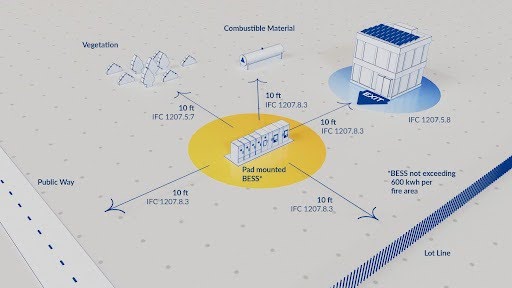
Even when a design stays within the MAQ for a given technology, the physical footprint required to place that quantity safely can still be limited by setbacks and easements that have nothing to do with the MAQ table itself. Section 1207.5.7 requires that combustible vegetation be cleared for 10 feet on each side of outdoor storage, and Section 1207.5.8 requires a minimum 10 ft separation between outdoor storage and any means of egress. On top of these code required distances, projects also have to account for utility easements that may not be visible on site and electrical equipment setbacks required by the National Electrical Code .
The San Diego project again shows how these constraints stack up. The only suitable outdoor location for the remaining battery racks sat on a slope, and that location also fell within a 10 ft vent setback, a 10 ft property setback, and a utility easement around a nearby transformer. The team ultimately had to grade and fill the hillside location to make it usable, an expense that had not been part of the original budget. Surveying a site early, and confirming the location of setbacks and easements before finalizing a layout, helps avoid discovering these invisible lines after a design is already underway.
Working With the AHJ Early: Why Fire Marshals Have Final Say
The exceptions built into Section 1207.5.2 and elsewhere in the code consistently include language allowing the fire code official to approve alternatives, whether that means a larger quantity than the table allows, a different separation distance, or an alternative fire suppression method under Section 1207.5.5. That approval authority means a design can follow the code to the letter and still be rejected if the authority having jurisdiction is not satisfied with the supporting testing or analysis behind it. A fire marshal who does not accept a manufacturer's large-scale fire testing report, for example, may still require a wider setback or additional fire protection measures regardless of what the table would otherwise allow.
Bringing the AHJ into the conversation early, before a design is finalized, gives officials the chance to weigh in while there is still room to adjust the plan. Showing that a project team is proactive about fire protection and willing to work through site specific concerns tends to go a long way toward a smoother approval process later on.
Planning Ahead for Space, Cost and Code Compliance in BESS Design
The MAQ table is ultimately a planning tool as much as it is a code requirement. Knowing the 600 kWh limit for lithium ion storage early in a project allows a design team to decide whether to stay under that limit, pursue a hazard mitigation analysis and budget for its cost, or shift some or all of the storage outdoors where there is more flexibility. Measuring available space accurately, accounting for required setbacks and existing equipment, and confirming property lines and utility easements before committing to a layout all help prevent the kind of late stage redesigns seen in the example project in San Diego. While some electrical equipment might be allowed to be tucked into tight spaces with a small footprint, battery storage does not offer the same flexibility once fire code requirements and community concerns about battery fires are factored into the design.
Author’s note: The 600 kWh MAQ threshold described in this article comes from the 2024 International Fire Code (IFC) and is aligned with the 2023 edition of NFPA 855. However, we anticipate the 2027 IFC to align with the recently released 2026 edition of NFPA 855, which reduces the MAQ threshold for lithium-ion energy storage systems all the way down to 20 kWh. In theory, this means that within the next few years all stationary storage projects above 20 kWh (in jurisdictions that adopt the 2027 IFC) will require an HMA or meet certain exceptions outlined by Code.
FAQs
Can a building use multiple fire areas to stay under the 600 kWh MAQ threshold in each?
Yes. Fire areas are defined either by the Fire Marshal or by fire-rated separations, so a project can subdivide a site to keep each area under the MAQ — though rated walls and separations add construction cost that should be weighed against the cost of a hazard mitigation analysis.
Does a manufacturer's UL 9540A test report satisfy the large-scale fire testing requirement, or does new site-specific testing have to be performed?
Manufacturer UL 9540A data can sometimes support the hazard mitigation analysis, but it's the AHJ's call whether existing test data is representative enough of the specific installation, or whether additional testing is needed.
How long does the hazard mitigation analysis and approval process typically add to a project schedule?
It varies by jurisdiction and how quickly the AHJ reviews the submission, but because the analysis and any required testing happen after a design is largely finalized, it's a schedule risk worth flagging to clients early rather than treating as a quick add-on.
Do residential battery storage installations follow the same Table 1207.5 limits as commercial systems?
Residential systems are often governed by different code paths (tied to dwelling occupancy requirements) rather than the commercial fire area provisions this article focuses on, so the applicable limits and process can differ — this is worth confirming with the local AHJ.
Do local jurisdictions ever adopt stricter limits than the IFC's base MAQ table?
Many jurisdictions amend the IFC when adopting it locally, and some impose lower quantity limits or additional review requirements for battery storage than the base code specifies, so the 600 kWh figure should be confirmed against local amendments before it's treated as fixed.