Pad Mounted BESS Setbacks Under the International Fire Code
Jun 23, 2026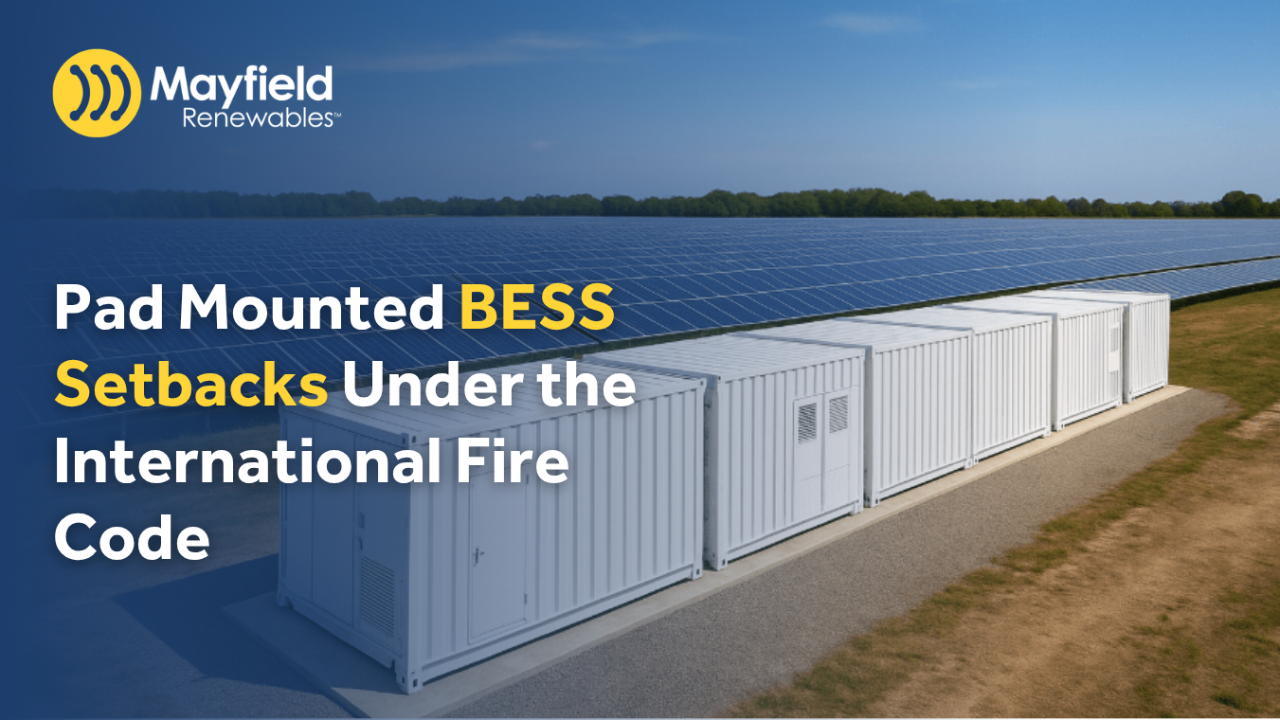
Engineers and developers working on C&I solar-plus-storage projects know that siting a pad-mounted battery energy storage system is rarely as simple as finding an open patch of ground. The International Fire Code establishes mandatory setback distances that govern how close a BESS can be to buildings, property lines, vegetation, and other equipment, and those distances have a direct impact on pad layout, site feasibility, and project cost.
This article breaks down the three IFC sections that drive most pad-mounted BESS setback decisions: 1207.5.1 (size and separation between ESS groups), 1207.8.3 (clearance to exposures like buildings and lot lines), and 1207.5.7 (combustible vegetation control). Each section is covered with its default requirement, the available exceptions, and the practical design implications that come up on real projects.
We also pull from a Mayfield Renewables Code Corner episode where our chief engineer Ryan Mayfield walked through a space-constrained dual-battery installation that required invoking multiple exceptions simultaneously.
Key Takeaways
- IFC 1207.5.1 requires 3-foot separation between BESS groups, reducible through large-scale fire testing.
- IFC 1207.8.3 requires 10 feet from outdoor ESS to buildings and other exposures, with exceptions down to 3 feet.
- IFC 1207.5.7 requires a 10-foot vegetation clearance with no exceptions available, but some allowances for non-combustible vegetation.
- Overhanging branches and building elements can create vertical clearance violations.
- NEC working space requirements apply independently of IFC setbacks.
Understanding IFC Requirements for Outdoor Battery Energy Storage Systems
The International Fire Code establishes the baseline safety framework for siting battery energy storage systems in the United States, and for C&I solar-plus-storage projects the setback provisions in Chapter 12 are where most of the design-level tension lives. IFC Section 1207 covers electrochemical energy storage systems, and within it, three sections govern the physical positioning of pad-mounted BESS: 1207.5.1 (size and separation), 1207.8.3 (clearance to exposures), and 1207.5.7 (vegetation control).
These sections do not exist in isolation. They interact with each other, with NFPA 855, and with project-specific constraints like available square footage, existing infrastructure, and the preferences of the Authority Having Jurisdiction (AHJ). While the 2024 IFC incorporated many provisions from the 2023 edition of NFPA 855, the two documents are not fully harmonized. Additionally, many state-level fire codes are based on the IFC (e.g., the California Fire Code) with varying degrees of amendments.Confirming which edition and which standard the AHJ is enforcing is a necessary first step before finalizing any BESS siting strategy.
How IFC Defines Separation Distances and Exposure Hazards
IFC 1207.5.1 establishes the foundational rule for spacing between ESS units. Electrochemical energy storage systems must be segregated into groups not exceeding 50 kWh, with each group separated by a minimum of 3 feet from other groups and from walls. The term “group” here might be confusing. We take “group” to mean “unit” in more colloquial terms. In other words, baseline Code requirements limit ESS unit capacities to 50 kWh and all units must be installed at least 3-feet apart.
At first glance, this may seem like an onerous requirement–many commercial-scale ESS units have nameplate capacities that exceed 50 kWh and installation manuals with per-unit separation distances that are less than 3 feet. What makes this possible are the exceptions to IFC 1207.5.1. Exceptions 1 through 3 apply only to legacy chemistries like lead-acid and nickel-cadmium in specific utility or UPS contexts. Exception 4, the one most relevant to modern lithium-based C&I installations, allows the fire code official to approve smaller separation distances or larger unit capacities based on large-scale fire testing complying with Section 1207.1.5, typically documented through a UL 9540A test report for the specific battery model.
IFC 1207.8.3 governs the relationship between an outdoor ESS and its surroundings. The default requires a minimum of 10 feet of clearance from the ESS to lot lines, public ways, buildings, stored combustible materials, hazardous materials, high-piled stock, and other exposure hazards. The 10-foot baseline is designed to limit the potential spread of a fire or explosion incident under worst-case scenarios, and it applies to any element of the surrounding environment that could ignite the BESS or be ignited by it.
The list is broad by design. Any element of the surrounding environment that could either ignite the BESS or be ignited by it falls under this section. The 10-foot baseline reflects a conservative margin. But much like the size and separation requirements of 1207.5.1, section 1207.8.3 includes exceptions that reduce the 10-foot baseline to as few as 3-feet if fire barriers are in place, exposed exterior buildings or walls are noncombustible, or if the ESS has undergone large-scale fire testing demonstrating that a fire within the enclosure will not spread outside the enclosure. More on that later in the article. .
Pad-Mounted BESS Setbacks from Buildings, Property Lines, and Other Equipment
On most C&I projects, the 10-foot clearance to buildings is the constraint that creates the most friction. Buildings are rarely designed with dedicated outdoor spaces for ESS that meet the 10-foot “clearance to exposure” requirements of the IFC. . The same requirement applies to lot lines, which compounds the problem on infill commercial sites or irregularly shaped parcels where a BESS must simultaneously avoid a building on one side and a property line on another.
Intra-unit separation requirements under 1207.5.1 stacks on top of these constraints, which can significantly expand the size of the equipment pad. NEC working space clearances in front of BESS inverters add yet another layer, and because the NEC operates independently of the IFC, both sets of requirements apply simultaneously. It’s critically important to not overlook these installation location constraints in the early stages of project development.
When Reduced Setbacks May Be Permitted Through Testing, Fire Protection, or AHJ Approval
IFC 1207.8.3 offers three exceptions that can reduce the 10-foot building clearance to 3 feet. Exception 1 requires a 1-hour free-standing fire barrier suitable for exterior use, extending 5 feet above and 5 feet beyond the ESS boundary. Exception 2 places the burden on the building itself, requiring a noncombustible adjacent wall with no openings and a minimum 2-hour fire-resistance rating; the presence of any door, window, or vent eliminates eligibility. Exception 3 requires a tested weatherproof noncombustible enclosure over the ESS, with large-scale fire testing under Section 1207.1.7 demonstrating that a fire inside the enclosure will not ignite materials outside it.
Unit-to-unit separation under 1207.5.1 Exception 4 follows a similar documentation path. A UL 9540A test report specific to the ESS model, submitted to the fire code official, is the mechanism for approving spacing below 3 feet. In the design case covered in Mayfield's Code Corner session, this reduced cabinet separation to 9 inches, substantially shrinking the concrete pad footprint while preserving room for future expansion.
Design Considerations and Common Challenges for Solar Plus Storage Developers
Space-constrained sites are where the IFC's BESS setback provisions become most visible as a design factor. Pursuing multiple exceptions simultaneously is common on these projects, and each exception requires its own documentation, AHJ coordination, and in some cases third-party testing data tied specifically to the equipment being installed.
Vegetation control under 1207.5.7 is a frequently underestimated constraint. The 10-foot clearance applies in all directions, including vertically, meaning overhanging tree branches that project into the zone are subject to removal even if the trunk sits outside the perimeter. The Code permits single specimens of non-fire-transmitting plants like green grass and ivy, but generally combustible vegetation must be cleared, and building overhangs that project over the ESS area raise the same compliance concern from the structure side.
Concrete pad design benefits from being built with expansion in mind from the start. Extending the pad to accommodate future cabinets, while maintaining required separations and projecting NEC working clearances across all planned phases, avoids revisiting AHJ approvals or modifying existing structures when additional capacity is added. Ask your client: is there a future where you would like to add more storage capacity onsite? If so, let’s get ahead of that by overbuilding the equipment pad now.
Conclusion: Applying IFC Setback Requirements to Real-World Projects
The IFC's setback framework for outdoor pad-mounted BESS is structured around default distances that provide a conservative safety margin, with defined exception pathways for sites where those defaults are not achievable through conventional means. The 3-foot unit separation in 1207.5.1 can be reduced through large-scale fire testing documentation. The 10-foot clearance to exposures in 1207.8.3 can be reduced to 3 feet through three distinct technical approaches. The 10-foot vegetation clearance in 1207.5.7 cannot be reduced through any exception, and the AHJ makes final calls on marginal cases.
C&I solar-plus-storage developers who address these provisions before layout begins, rather than treating them as a permitting check at the end of the design process, substantially reduce the risk, costs, and extended timelines that come witha later-stage redesign. The exception pathways are real and usable, but they require documentation that must be tied to specific equipment and verified by the fire code official. Building that process into the project schedule early is the most reliable way to keep setback compliance from becoming a constraint that reshapes a project late in development.
Frequently Asked Questions
Does the IFC apply uniformly across all jurisdictions, or do local amendments change the setback requirements?
The IFC is a model code and jurisdictions adopt it with varying amendment cycles and local modifications. Always confirm which edition and amendments the AHJ is enforcing before finalizing a setback strategy.
What documentation does the fire code official typically expect when invoking an exception?
Expect to provide the UL 9540A test report for the specific ESS model, a narrative tying the test results to the proposed design, and often a manufacturer confirmation that the installation matches tested parameters. Work with the ESS vendor to obtain this documentation as needed.
At what point in the project timeline should setback compliance be resolved?
Setback strategy should be confirmed during schematic design, before the pad layout is fixed. Exception approvals and vegetation removal can affect structural design, civil grading, and landscape permits.
Can a single installation trigger more than one setback exception simultaneously?
Yes, and it is common on constrained sites. Each exception requires its own supporting documentation and is evaluated independently by the AHJ.