Transformer Primary vs. Secondary Sides per NEC 705.30(F)
Sep 03, 2026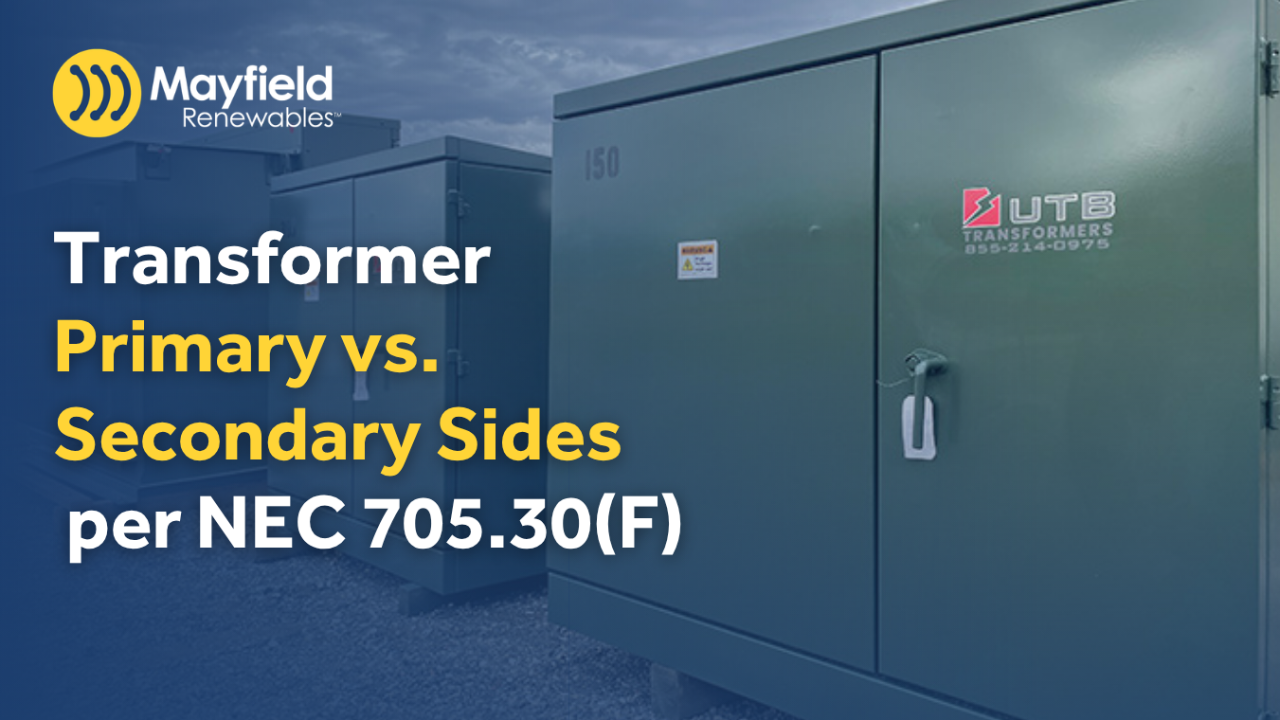
Anyone who has specified a transformer for a solar or storage interconnection has likely run into confusion about the primary and secondary windings. The assumption that the high-voltage side, or the side that is generating current, is always the primary leads to real ordering mistakes, and those mistakes can turn into an expensive piece of equipment that never gets installed.
NEC 705.30(F) settles the question with a definition that has nothing to do with voltage at all. This article breaks down what the code actually says, where the common mistake comes from, and a simpler way to talk about transformer windings that removes the ambiguity entirely.
The Voltage Assumption That Leads to Incorrect Transformers Orders
A common scenario involves a utility service at 208 V and an inverter operating at 480 V. A team orders a 480 to 208 transformer, assuming the 480 side is the primary because the inverter is producing power from that side. What typically arrives is a 480 delta to 208 wye transformer, since that configuration is the standard workhorse for general distribution systems.
But once the transformer is delivered, the team discovers that the inverters need a wye connection on the 480 side, and a delta winding cannot provide the neutral they require. A solidly grounded secondary neutral will allow the inverters to read balanced phase-to-ground voltages. In most cases, an unbonded (floating) secondary will result in inverter-phase-imbalance faults. At that point, the transformer is essentially unusable for the application, and the project is stuck with an expensive piece of equipment that has to be swapped out.
What NEC 705.30(F) Actually Defines
NEC 705.30(F)(1) directly defines the primary side of the transformer. It states that, for overcurrent protection, "the primary side of a transformer with sources on each side shall be the side connected to the largest available source of fault current." In most interconnection scenarios, that means the utility side is treated as the primary.
NEC 705.30(F)(1) adds a related requirement. It states that transformer secondary conductors must be protected in accordance with 240.21(C), which directly ties the primary and secondary designations to the application of overcurrent protection on each side of the transformer.
Why "Grid-Side" and "Inverter-Side" Beat "Primary" and "Secondary"
NEC language clarifies the overcurrent protection question, but it does not resolve the communication problem between a design team and a transformer manufacturer. Referring to windings as "primary" and "secondary" still leaves room for someone on the other end of the conversation to assume voltage determines which is which.
The better practice is to stop using primary and secondary altogether when specifying equipment for DER projects, and instead describe each winding by what it connects to. Calling one side the "grid-side" and the other the "inverter-side" completely removes ambiguity, since it does not matter whether the person reading the spec knows the NEC definitions of primary and secondary.
Conclusion
The practical takeaway for anyone specifying a transformer for a solar or storage interconnection is to confirm the required winding configuration on each side before placing an order, and describe the equipment using "grid-side" and "inverter-side" terminology rather than primary and secondary.
A single change in vocabulary prevents important details from being lost in translation and ensures that key transformer specs are understood by all stakeholders, regardless of which side actually carries more voltage.
Frequently Asked Questions
Does NEC 705.30(F) apply to every transformer on a project, or only ones used for interconnection?
This section applies specifically to transformers with sources on both sides, covering the interconnection equipment between a utility and an inverter-based system. A transformer that only steps voltage up or down within a system, with no separate source on the other side, is not addressed in this section.
Do inspectors expect drawings to use primary and secondary language, or is it acceptable to use "grid-side" and "inverter-side" on submitted plans?
Most inspectors care more about correct overcurrent protection and winding configuration than the specific wording on a drawing. Using grid-side and inverter-side labels, alongside the primary and secondary labels required for code compliance, is generally a safe way to keep both the inspector and the equipment manufacturer on the same page.