2026 NEC Changes to 705.11(C) for Supply-Side Connections
May 12, 2026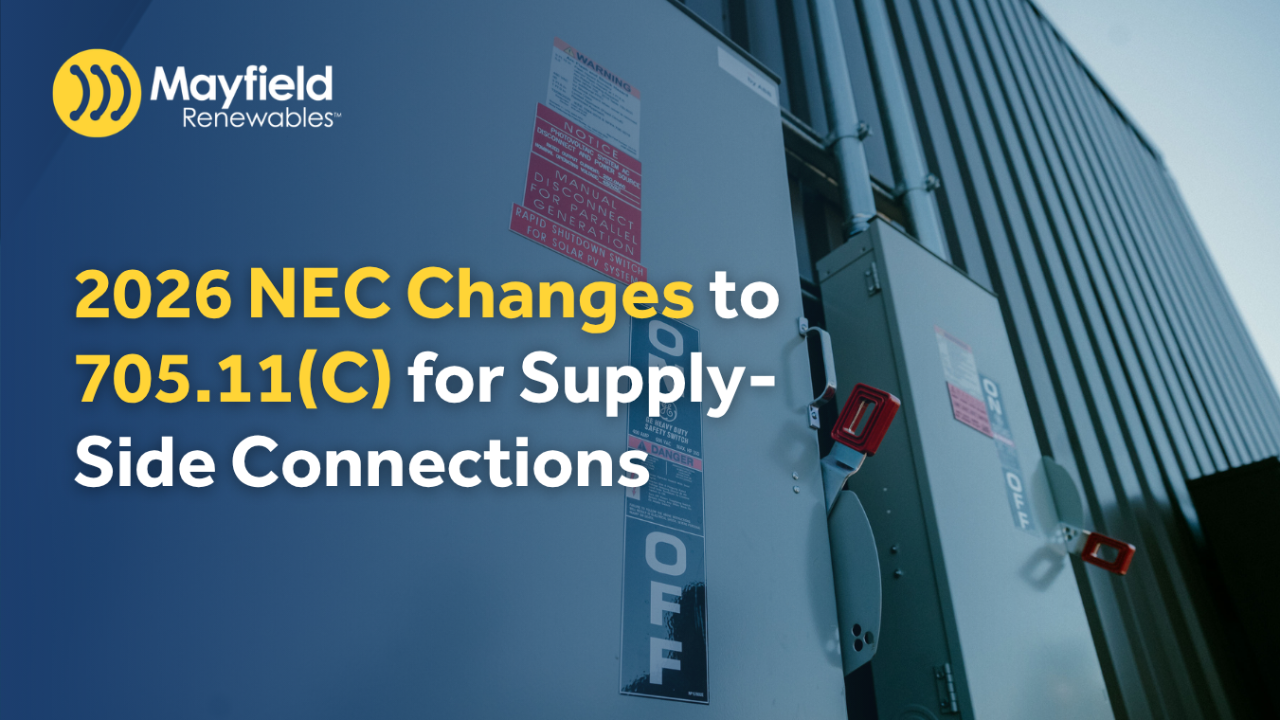
When interconnecting a power production source on the supply side of the service disconnect, NEC 705.11 governs the rules of engagement. Supply-side connections made ahead of the main overcurrent protective device (OCPD) operate under service-equivalent conditions, which means the code treats conductor protection, fault current exposure, and equipment ratings with the same scrutiny applied to utility services.
Section 705.11(C) specifically addresses overcurrent protection requirements for power source service conductors. These are the conductors running from the point of connection on the supply side to the first OCPD on the PV or power production system. Getting this right isn't just a code compliance exercise; unprotected conductors in this zone are exposed to the full available fault current of the utility, with no upstream device to clear a fault.
The rules governing this section have evolved across the 2020, 2023, and 2026 NEC cycles in ways that have real consequences for system design and layout, particularly around permissible conductor lengths and the conditions under which overcurrent protection must be provided. What follows breaks down those requirements, traces the code evolution, and identifies the practical design implications for supply-side interconnections.
Key Takeaways
- The 2026 NEC reinstates the distance based framework from the 2020 edition, making the 2020 Code language the closest reference point for those anticipating 2026 requirements under the 2023 edition.
- Power source service conductors connected inside a building must have an OCPD within 3 m (10 ft) in dwelling units and 5 m (16.5 ft) in “other than dwelling units” from the point of connection, limits that are reached quickly once real-world routing is accounted for.
- The engineering supervision exception allows an OCPD to be located up to 20 m (66 ft) from the point of connection in other than dwelling units, provided cable limiters are installed on all ungrounded conductors within 5 m of the point of connection.
- Any OCPD used to satisfy the distance requirements in 705.11(C)(1) must comply with 705.30, which governs sizing, backfeed suitability, and marking requirements for power source installations.
What Changed Between NEC 2020, 2023, and 2026?
The 2020 NEC established explicit distance requirements for overcurrent protection of power source output circuit conductors connected inside a building, with defined thresholds for dwelling units (3 m / 10 ft) and other than dwelling units (5 m / 16.5 ft), along with an engineering supervision exception.
The 2023 NEC removed those distance requirements entirely, directing overcurrent protection to comply with Part VII of Article 230 and expanding the section to a six-part (A) through (F) structure.
The 2026 NEC returns to the framework established in 2020. The distance thresholds and engineering supervision exception are reinstated, and the section is consolidated from six subsections down to three. Overcurrent protection requirements are organized under 705.11(C)(1) with three clearly enumerated methods covering dwelling units, other than dwelling units, and the engineering supervision exception. For those working under the 2023 NEC, the 2020 code language is the closer reference point for anticipating 2026 requirements.
Breaking Down 705.11(C)(1): Overcurrent Protection Requirements
Overcurrent protection for power source service conductors under 705.11(C) is governed by requirements that establish how OCPDs must be sized, evaluated for backfeed, marked, and applied in installations where multiple sources are present. When making a supply-side connection, these requirements are essential to understand, as any OCPD used to satisfy the distance thresholds in 705.11(C)(1) must comply with 705.30.
705.30 covers OCPD requirements for power source output conductors and equipment, including sizing, backfeed suitability, marking, and transformer protection. Of particular note for supply-side connections, OCPDs must be sized to carry not less than 125 percent of the maximum currents calculated in 705.28(A), and circuits connected to more than one electrical source must have OCPDs located to provide overcurrent protection from all sources. Equipment containing OCPDs supplied from interconnected power sources must also be marked to indicate the presence of all sources.
Dwelling and Non-Dwelling Building Criteria
705.11(C)(1) prescribes specific compliance methods depending on the building type. Where power source service conductors are located within a building and connected to existing service conductors or equipment, the following applies:
In dwelling units, an OCPD must be located within 3 m (10 ft) of conductor length from the point of connection. This limits the length of unprotected conductor between the utility service and the PV system disconnect, and in practice, 10 ft of conductor length is consumed quickly once routing through walls, ceilings, or conduit runs is accounted for. This leaves little to no margin for remotely locating the overcurrent device or disconnect, and installers should plan the point of connection with this constraint in mind from the start of design.
In other than dwelling units, an OCPD must be located within 5 m (16.5 ft) of conductor length from the point of connection. Commercial and industrial installations have slightly more flexibility, but the same routing considerations apply, and the threshold can be reached quickly depending on the layout of the service equipment and available wall space.
Why These Distance Limits Matter
The informational note to 705.11(C)(1) states that the distance limits are intended to provide guidance on practical distances for unprotected power source service conductors inside buildings. The underlying intent is to minimize the length of unprotected conductors within the building, as these conductors are exposed to the full available fault current of the utility with no upstream device to clear a fault.
The shorter the unprotected run, the less exposure there is to a fault event inside the building envelope. This is the same rationale that governs service entrance conductor protection under Article 230, and supply-side connections are held to that same standard of risk.
Potential Problems
The 3 m (10 ft) limit in dwelling units is the more restrictive of the two thresholds and will be consumed quickly once conduit routing, bends, and physical distance between the service equipment and the PV disconnect are accounted for. This leaves little to no flexibility for remotely locating the overcurrent device, and in many residential installations the point of connection and the disconnect must be in close proximity by necessity rather than preference.
This physical constraint can become a design problem early in the planning process if the point of connection is selected without accounting for the 10 ft limit. Once the service equipment location is fixed, options for routing and equipment placement narrow considerably, and retrofitting a layout that exceeds the threshold is costly and disruptive.
Engineering Supervision Exception: Cable Limiters and the 20 Meter Rule
Section 705.11(C)(1)(3) provides a third method of compliance under engineering supervision, applicable to services not over 1000 volts ac, nominal, in other than dwelling units. This exception is not available for dwelling units and requires satisfaction of both of the following conditions:
- First, one cable limiter per ungrounded conductor must be installed within switchgear or similar enclosures, including motor control centers, panelboards, or other listed enclosed assemblies, and within 5 m (16.5 ft) of conductor length from the point of connection.
- Second, an OCPD must be located within 20 m (66 ft) of conductor length from the point of connection.
The cable limiters serve as the first line of protection in the zone between the point of connection and the OCPD, limiting the extent of damage in the event of a fault on an ungrounded conductor before the OCPD can operate. The 20 m threshold gives commercial and industrial installations significantly more flexibility in locating the overcurrent device relative to the point of connection, which is particularly relevant in larger facilities where service equipment and PV disconnects may be separated by considerable distance.
Conclusion
NEC 705.11(C) is one of the more consequential sections for supply side PV system design, and the 2026 edition brings meaningful changes that designers, installers, and AHJs need to account for. The return to explicit distance requirements, the reinstatement of the engineering supervision exception, and the consolidation of the section into a cleaner structure all have direct implications for how these systems are laid out and reviewed.
Understanding how these requirements apply in the 2026 NEC makes it easier to navigate design decisions, permitting, and inspection with confidence. Knowing where overcurrent protection is required, what distance thresholds apply, and when the engineering supervision exception is available are the building blocks of a compliant supply side interconnection.
If you want to go deeper into how the 2026 NEC applies to PV systems, you can register for our online workshop that covers 2026 NEC Updates to PV Systems.
Mayfield Renewables is an engineering consultancy specializing in commercial and industrial PV and microgrid engineering. Contact us today for a consultation.
Frequently Asked Questions
1. Does 705.11(C) apply to load side connections?
No. 705.11 specifically governs supply side connections, made on the utility side of the main service disconnect. Load side connections are covered under 705.12.
2. Can the engineering supervision exception be used in a dwelling unit?
No. 705.11(C)(1)(3) is explicitly limited to other than dwelling units. Dwelling unit installations must comply with the 3 m (10 ft) OCPD distance requirement with no exception available.
3. Does the 10 ft and 16.5 ft distance requirement measure in a straight line or by conductor length?
The code specifies conductor length, not straight-line distance. Every bend, offset, and vertical run counts toward the threshold, which is why the limits are reached faster than they may appear on a plan set.
4. What qualifies as engineering supervision under 705.11(C)(1)(3)?
The NEC does not define engineering supervision within 705.11, but it is generally understood to involve a licensed engineer taking responsibility for the design. Jurisdictions may have specific interpretations, and early coordination with the AHJ is advisable.
5. Does the 2026 NEC require cable limiters in dwelling units?
No. Cable limiters are only applicable under the engineering supervision exception in 705.11(C)(1)(3), which is limited to other than dwelling units.